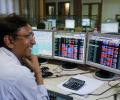
Equity benchmark indices Sensex and Nifty settled higher on Thursday, powered by a rally in banking and power stocks amid a largely firm trend in global markets. The stock markets mostly traded range-bound in the absence of any major trigger and persistent foreign capital outflows, traders said. The 30-share BSE Sensex rose 144.31 points, or 0.18 per cent, to settle at 81,611.41.

'As the markets are expected to remain jittery in the near term, we advise investors to use this opportunity to enter quality largecaps from a long-term perspective.'
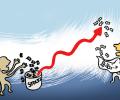
The worst may perhaps be over for these stocks, suggests Sanjay Kumar Singh.

Ask rediffGURU Reetika Sharma your insurance, mutual fund and personal finance-related questions.

Investors' wealth eroded by Rs 5.98 lakh crore on Thursday, tracking weak trends in equities where the BSE Sensex tumbled 1 per cent. Benchmark indices Sensex and Nifty declined 1 per cent in tandem with weak global market trends amid growing tensions in the Middle East.
Pharma was the top losing index amid worries about their earnings outlook with Lupin down over 4%

Draft Red Herring Prospectus (DRHP) filing continued to be robust in October, signifying the optimism in the initial public offer (IPO) market despite the recent turbulence in equities. In October, 17 companies filed their offer documents for IPOs. The rush in filings has made August-October 2023 the best three-month period for DRHP filings since July-September 2021.

Tech Mahindra was the top loser in the Sensex pack, shedding over 3 per cent, followed by NTPC, IndusInd Bank, Kotak Bank and Reliance Industries. NSE Nifty fell 185.60 points to 17,671.65.

The number of dematerialised (demat) accounts - required to hold shares and other securities in electronics format - crossed the 150-million mark for the first time in March. In March, 3.12 million new demat accounts were added despite a spike in market volatility, taking the total count to 151.4 million. The milestone has come 19 months after the total number of demat accounts hit the 100-million mark, a sign that more domestic households are taking to direct equity investing.

From the Sensex pack, HCL Technologies, Infosys, Wipro, Bharti Airtel, Larsen & Toubro, Mahindra & Mahindra, Tata Consultancy Services and Asian Paints were the major gainers. Axis Bank, IndusInd Bank, Bajaj Finance, JSW Steel, State Bank of India and Tata Steel were among the major laggards.

From the Sensex pack, Larsen & Toubro jumped 4.26 per cent to emerge as the biggest gainer, followed by IndusInd Bank, Tech Mahindra, State Bank of India, HCL Technologies, Power Grid, NTPC, Axis Bank, Kotak Mahindra Bank, HDFC Bank and Wipro. Mahindra & Mahindra, Infosys, UltraTech Cement and Hindustan Unilever were the major laggards.

From the 30-share pack, Sun Pharma, TCS, Tech Mahindra, NTPC, Wipro, UltraTech Cement, Dr Reddy's Laboratories and Infosys were the major gainers, jumping up to 3.99 per cent. In contrast, Tata Steel, Nestle, Titan Company, PowerGrid, Reliance Industries Limited and State Bank of India were among the laggards.

The Nifty ended at 5,607, down 4 points. The markets opened on a nervous note on the back of weakness across Asia and apparent profit-booking post the gains of the previous two sessions.

Among the Sensex firms, Nestle rose the most by 4.66 per cent. NTPC rose by 2.16 per cent, Reliance Industries by 1.53 per cent, State Bank of India by 1.04 per cent and Hindustan Unilever by 1.03 per cent. ITC, Power Grid and Bajaj Finance were the major gainers. Wipro, Tata Consultancy Services, HCL Technologies, Tata Steel, Bajaj Finserv and Maruti were among the laggards.

Mid and small-cap stocks have been the stars of Indian stock markets this year. Recognising this, mutual funds have launched a plethora of schemes targeted at this universe of stocks this year.

'Some risks to this market rally include inflation, erratic weather conditions, rising crude prices, slowing global growth and the resultant impact on domestic exports, escalation in geopolitical tensions.'

'Even if India is attractive, FPIs currently lack the funds to invest, as money is being redirected to the US.'

Equity benchmark indices Sensex and Nifty declined for the second straight session on Friday following selling in banking, financial and select IT shares amid a weak trend in global markets. The 30-share BSE Sensex dropped by 125.65 points or 0.19 per cent to close at 66,282.74 as 16 of its constituents fell and 14 advanced. The index opened lower and fell further by around 513 points to the day's low of 65,895.41 in morning deals.
The NSE Nifty gained 50 points to close at 3553.
As many as 267 of 453 companies from the BSE500 index are trading above their consensus price targets, according to the data compiled by Bloomberg. Not all companies in the BSE500 index are tracked by analysts.

If you are overweight on fixed-income instruments, go for ELSS, and vice versa.

Brokerages believe that the Bharatiya Janata Party's (BJP's) stronger-than-expected showing in state elections reduces political risks for the domestic markets going into 2024. However, after the short-term excitement, the focus will soon shift to earnings, global liquidity conditions, and the interest rate trajectory. "BJP's win in the three state elections is much better than what exit polls suggested and reinforces the consensus expectations of a Modi win in the 2024 national elections with a greater likelihood of 300+ seats for the BJP.

The S&P BSE Sensex zoomed 500 points to end at 27,627, the highest level in almost 9 months.

Stock markets will be largely driven by global trends in the absence of any major domestic triggers this week, say analysts. The trading activity of foreign investors, global crude oil prices and rupee-dollar movement will also influence market movement, they said. "Anticipating a period of consolidation in the absence of clear global cues, the market's trajectory will likely hinge on the movement of the US bond yields, the dollar index, and crude oil prices, as well as institutional flows.

Among the Sensex firms, Tata Steel, Tata Motors, Asian Paints, Wipro, State Bank of India and Larsen & Toubro were the major gainers. ICICI Bank, NTPC, Axis Bank and Mahindra & Mahindra were among the laggards.

Riding the wave of the equity market, the mutual fund (MF) industry experienced double-digit growth in Samvat 2079, concluding the Hindu calendar year close to the Rs 50 trillion assets under management milestone. After a subdued 6 per cent growth in Samvat 2078, the industry's assets surged over 18 per cent last year to Rs 46.7 trillion. Industry players anticipate that Samvat 2080 will also be a fruitful year for the asset management industry, given the strong inflows from retail investors, particularly through the systematic investment plan route.

Following the sharp run in markets, valuations across the board have become elevated. The National Stock Exchange Nifty50 Index now trades at a 12-month trailing price-to-earnings (P/E) multiple of 24.3 times, 18 per cent higher than this year's low of 20.5 times. The valuation expansion in the broader markets has been sharper.

S&P BSE Midcap index and S&P BSE Smallcap were down 2% and 1.3% respectively
Among Sensex stocks, Wipro gained the most by 3.29 per cent. Ultratech Cement, Reliance Industries, Hindustan Unilever, Nestle, NTPC, M&M, HDFC Bank, ITC, Kotak Bank and Axis Bank were among the winners. On the other hand, HCL Tech fell the most by 1.24 per cent. SBI, TCS, Infosys, IndusInd Bank and Tata Steel also dropped.

'The market's sharp decline recently has shaken the confidence of retail investors, leading to increased selling.'

Dr Reddy's was the top gainer in the Sensex pack, rising over 3 per cent, followed by PowerGrid, TCS, HCL Tech, Infosys and Reliance Industries. On the other hand, L&T, IndusInd Bank, Bajaj Finserv and Bharti Airtel were among the laggards.
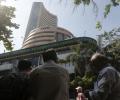
Among the Sensex firms, Tech Mahindra, Tata Motors, Bharti Airtel, Wipro, Bajaj Finserv, HCL Technologies, Bajaj Finance, Larsen & Toubro, Mahindra & Mahindra and UltraTech Cement were the biggest laggards. IndusInd Bank, Power Grid, HDFC Bank, ICICI Bank, NTPC, Reliance Industries, HDFC and Tata Steel were the prominent winners.

Overall market reaction to the Budget was neutral. Investors absorbed the changes to the tax rates (positive for salaried class) and capital gains taxes (CGTs, negative due to the removal of indexation and increases. Other proposals largely pertain to supporting rural development, buybacks taxed as dividends, Custom duty changes that impact multiple sectors, higher outlays for clean energy, etc. There's some moderation in the growth of capex outlay across defence, fer

Sun Pharma, Tata Steel, State Bank of India, Axis Bank, Tata Motors, Larsen & Toubro and ICICI Bank were also among the Sensex gainers. HCL Tech, UltraTech Cement, Nestle and Hindustan Unilever were among the laggards.

So far in 2017, the Nifty has gone up by 22.4 per cent.

'Sell in May, go away' is a popular market adage. But 'Don't sell any new shares in May' is the best kept secret of Dalal Street that's set to break. Sample this: the last four General Election election cycles starting 2004 have not seen a single initial public offering (IPO) launch during the month of May.

'It is advisable to stay away from the markets for now and buy only on a dip.'

Shares of small-cap companies have been on a roll with the S&P BSE Small-Cap index hitting a new high in intra-day deals on Thursday. The rally has been fueled by an up move in stocks of chemicals, cement, graphite electrode makers, pharmaceuticals and information technology (IT) shares. In the past two weeks, since March 25, the index has outperformed the market by gaining 7.3 per cent. In comparison, the S&P BSE Midcap index was up 6.1 per cent, while the S&P BSE Sensex gained 3.6 per cent during the same period.
ONGC was the top gainer in the Sensex pack, rallying around 5 per cent, followed by NTPC, Reliance Industries, IndusInd Bank, Axis Bank and PowerGrid. NSE Nifty rose 115.35 points to reclaim 15,000 level.

The total number of demat accounts in the country stood at 171.1 million as of August 31.
